
Linn County Court Records After a Jail Arrest
After a Linn County arrest, the first public trail often starts with booking at the Linn County Correctional Center. That custody entry is not the same thing as the court case. The court record begins to matter when a complaint, trial information, indictment, hearing notice, bond order, or other filing is entered in the Iowa court system. The practical path is arrest, booking, arraignment or initial appearance, prosecutor review, filed charges, docket events, and disposition.
The jail side answers a custody question: is the person currently booked into the county jail? For that, use jail inmate records. The booking-photo and roster-photo topic belongs with jail mugshots, because Iowa Courts Online should not be treated as a mugshot source. The court side answers a different question: what case was filed after the arrest, what charges are on the docket, what happened at hearings, and whether any charge ended in dismissal, plea, conviction, sentence, or another court order.
How to Find Linn County Court Records After an Arrest
For filed criminal cases, the official statewide search channel is Iowa Courts Online Search. Linn County's local arraignment resources also route users to Iowa Courts Online for case information and to the Linn County Clerk of Court for future court dates. The jail roster can be useful before a case appears, but once the prosecutor files charges, the docket is the better place to read the court record after the arrest.
- Open Iowa Courts Online Search and begin with the defendant's name. If a case number is already known, use that to avoid confusing people with similar names.
- Look for a Linn County criminal case tied to the arrest date, booking date, or first appearance. A new case may not be visible immediately after booking.
- Open the case and read the caption, charge list, hearing entries, bond orders, and docket history. The docket is where amended charges and later dispositions appear.
- Compare every charge separately. One charge may be pending while another is dismissed, amended, reduced, or resolved by plea or trial.
- If the online docket does not answer the timing question, contact the Linn County Clerk of Court at 319-398-3411 for future court dates.
The Iowa Courts Online screen is the subject-matched source for post-arrest case lookup. Source: Iowa Courts Online Search.
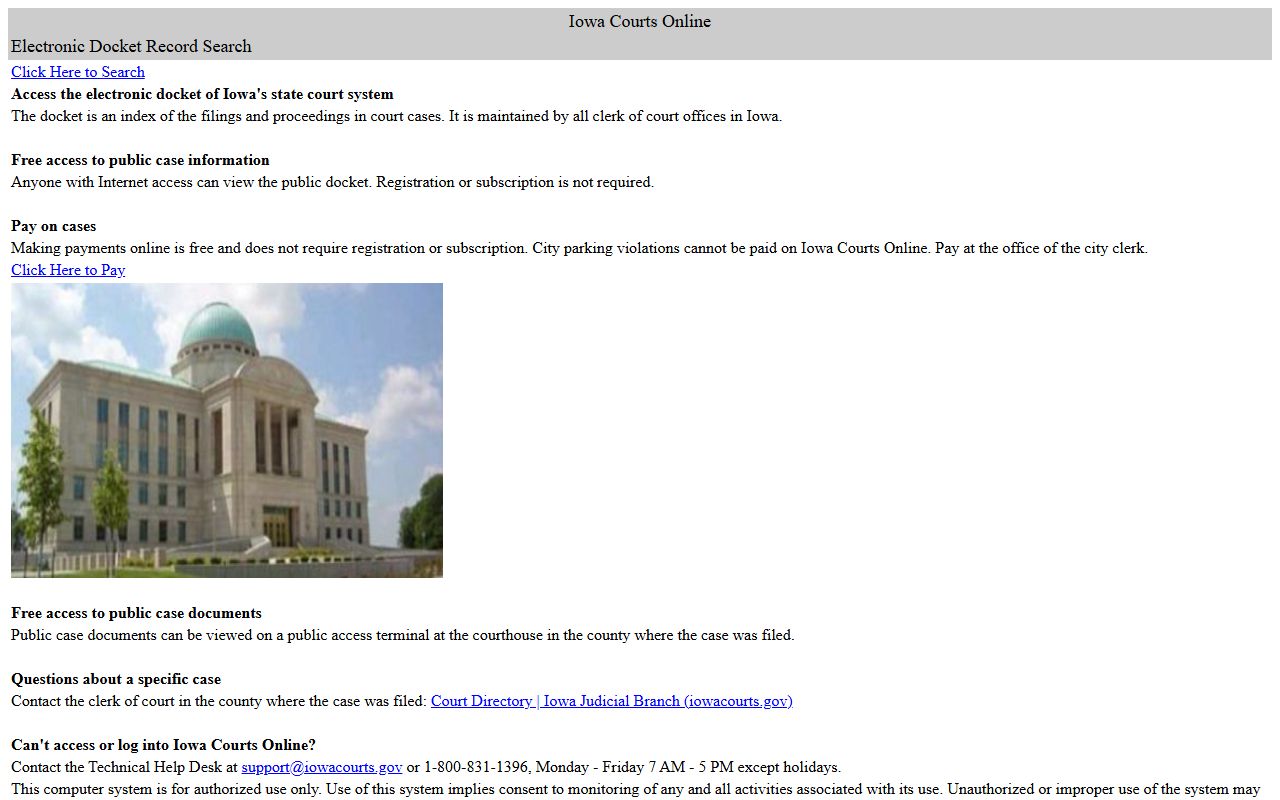
Use the docket for filed charges and case events, then use the jail or records-request channels only when the question is about custody, booking, or sheriff-held records.
How Charges Get Filed After an Arrest: Complaint, Trial Information, and Indictment
A Linn County jail arrest can begin with an officer's booking information, but the charge record becomes a court record through a charging document or docket filing. In Iowa criminal practice, the common terms include complaint, trial information, and indictment. The name of the document matters because it tells the reader who initiated the charge and where the case is in the charging process.
| Document | Usually Filed By | Practical Role | What to Check |
|---|---|---|---|
| Complaint | Officer or prosecutor | Often starts the criminal case or states probable cause after arrest. | Alleged offense, factual basis, defendant name, and initial court date. |
| Trial Information | County Attorney | Prosecutor-filed charging document used in Iowa criminal proceedings after early stages. | Final filed charge wording, Iowa Code citation, and any minutes of testimony references. |
| Indictment | Grand jury | Grand-jury charging document, less common than prosecutor-filed information in many state cases. | Indicted counts, offense level, and later arraignment or plea entries. |
The Linn County Attorney's Office prosecutes criminal violations defined by the Iowa Code. Its Criminal Division is the local office most directly tied to charging decisions after arrest and booking. Attorneys seeking discovery are routed to the County Attorney, not to the Sheriff's open-records form.
Charge Status in Court Records After an Arrest
Booking charges and court charges can diverge. The arresting agency may book a person under one description, then the prosecutor may file a narrower, broader, amended, or different charge. A court record after a jail arrest should be read count by count, not as one flat result. The status line also changes over time as hearings occur, plea discussions continue, or the court enters a ruling.
| Status | What It Means | Why It Matters |
|---|---|---|
| Pending | The charge remains open and has not reached a final disposition. | Future hearings, bond conditions, and no-contact or release terms may still control. |
| Amended or Reduced | The filed charge changed from an earlier version. | The current charge may be different from the booking label or first complaint. |
| Dismissed | The court ended that charge without a conviction on that count. | Other counts in the same case may still be pending or resolved differently. |
| Convicted or Pled | The charge ended in a guilty finding or plea accepted by the court. | Sentencing, probation, jail time, fines, or state-prison transfer may follow. |
Bond and Release Timing After a Linn County Arrest
Linn County's arraignment resources give the local timing rules that connect jail booking to court. If a person is arrested before 6:30 a.m. on a weekday, court is scheduled for 10:00 a.m. If the person is arrested before 5:30 a.m. on a weekend or holiday, court is scheduled for 9:30 a.m. Court proceedings may be viewed at 50 3rd Avenue Bridge in Cedar Rapids on weekdays, excluding holidays and weekends.
Bond is not a single uniform process. Linn County says an inmate's bond can be posted at the Clerk of Court during normal business hours or through a bail bondsman. If the Clerk of Court is closed, a cash-only bond can be brought to the jail lobby window where the county rules allow it. All arraignment bonds must be posted at the jail. Iowa Code chapter 804 supplies the broader arrest and initial-appearance framework, and Iowa Code section 804.21 addresses initial appearance after a warrant arrest, release, and bond schedule.
| Bond or Hold Type | How It Works in Practice |
|---|---|
| Cash Bond | Money is posted directly when the court permits release on cash terms. After Clerk closure, Linn County identifies the jail lobby window as the cash-only route where allowed. |
| Surety Bond | A bail bondsman may post a bond when the court's order allows that method. |
| Own Recognizance | The court may release a person without a cash deposit if the order allows release on promise to appear and comply with conditions. |
| Hold or Detainer | Another agency, warrant, federal matter, ICE issue, or court order may keep a person in custody even when one local bond issue appears resolved. |
Linn County's local arraignment screen collects the bond and court-date rules in one place. Source: Linn County Arraignment/Resources.
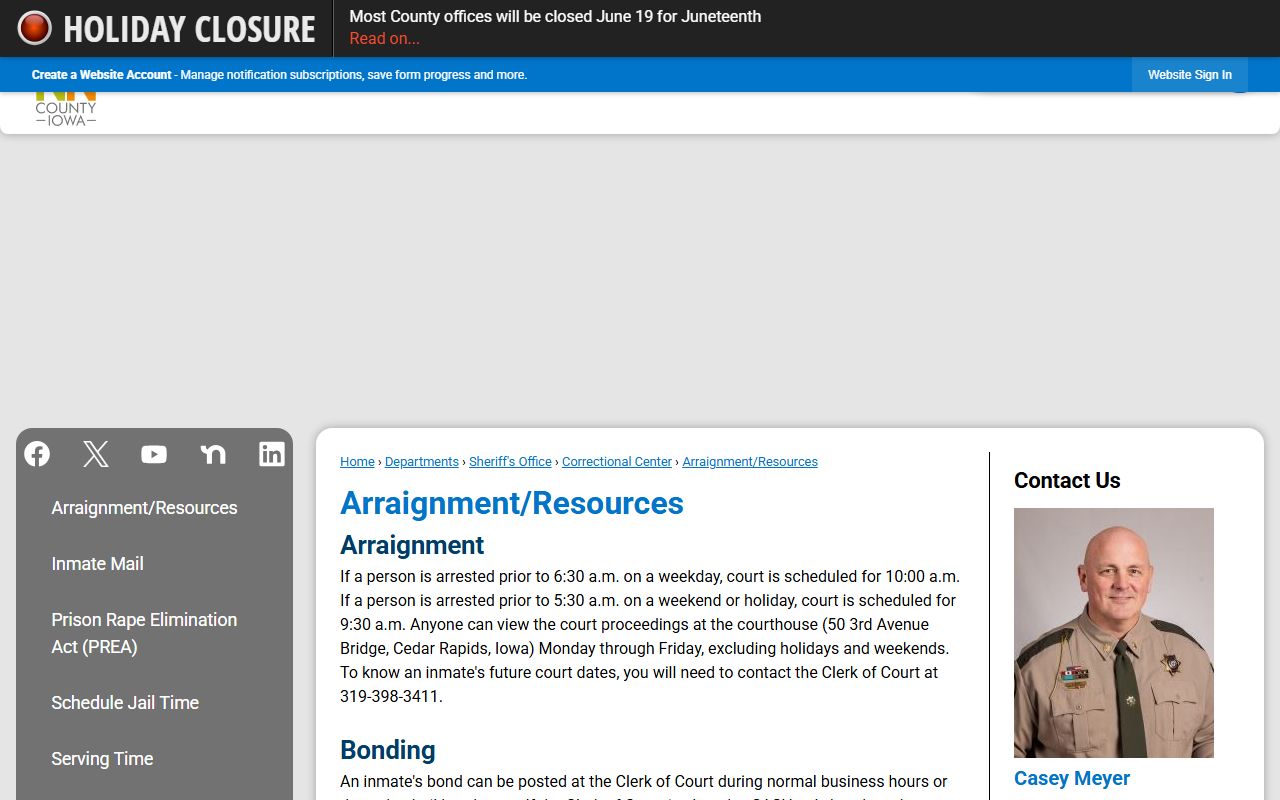
That local page is useful when a docket search gives the case number but does not explain first-appearance timing, Clerk contact, or after-hours bond routing.
Warrants That Lead Back to Arrest and Court Records
No standalone official Linn County public warrant-search portal was confirmed in the research. Warrant information may appear through the court docket, the Clerk of Court, custody records, or attorney communications. Iowa Code chapter 804 governs arrests and prisoner disposition, while Iowa Code section 804.21 specifically covers an initial appearance before a magistrate after arrest by warrant.
Linn County's jail-time scheduling pages add a practical local warning. A person ordered to serve jail time must schedule as instructed. For work release, GPS, or medical-exemption cases, failure to schedule within 15 calendar days of the court order may result in a warrant for immediate arrest. Missing a scheduled surrender date results in a warrant, and once a warrant is issued, the person cannot reschedule without an amended court order. If surrender will be missed, Linn County says rare amendments require 48-hour notice.
Charges vs. Convictions in Court Records After Arrest
A charge is an accusation filed in court. A conviction is a final adjudication, usually after a plea, verdict, or other legally sufficient disposition. A person can be arrested and charged without being convicted. A person can also have several charges in one case, with different outcomes for each charge. That is why Linn County court records after a jail arrest should be checked for both the charge list and the disposition entries.
| Charge | Conviction | |
|---|---|---|
| Stage | Allegation filed in the court case. | Final finding or plea outcome accepted by the court. |
| Proof Level | Starts from probable cause or a charging decision. | Requires proof or admission sufficient for judgment. |
| Where to Verify | Iowa Courts Online, Clerk of Court, and filed charging documents. | Disposition, judgment, sentencing, and certified court records. |
| Custody Link | May explain why the person was booked or held. | May result in jail, probation, prison, fines, or other orders. |
Sealed vs. Expunged Court and Arrest Records
Iowa public access starts with Iowa Code chapter 22, but public access is not unlimited. Iowa Code section 22.7 identifies confidential-record categories, including peace officer investigative reports in specified contexts. Juvenile cases, sealed cases, expunged matters, deferred dispositions, confidential records, and active investigative records may not appear in the same way as ordinary public criminal dockets.
| Sealed | Expunged | |
|---|---|---|
| Public Visibility | Hidden or restricted from normal public access by court rule or order. | Removed or treated under the expungement statute or order that applies to the record. |
| Agency Access | Courts and law-enforcement agencies may retain limited access depending on the order. | Access depends on the specific Iowa law, court order, and record type. |
| Typical Trigger | Juvenile, confidential, protective, or otherwise restricted case material. | Eligible dismissal, deferred, or other disposition where Iowa law allows expungement. |
| Practical Check | Ask the Clerk of Court what public access exists for the case number. | Confirm with the Clerk of Court or counsel whether the order has been entered and processed. |
Background Check Considerations
Casual court lookup is not the same as a compliant background check. Iowa Courts Online, the Linn County Clerk of Court, the Sheriff's Office records process, Iowa DOC, BOP, ICE, and Iowa VINE all answer different questions. A court docket may show charges and outcomes, while a jail roster may only show current custody. A consumer report used for credit, employment, housing, insurance, or a similar screened decision has separate legal requirements.
Important: Linn County Inmate Population is not a consumer reporting agency and must not be used for FCRA-covered decisions.
Restricted Court Records After an Arrest in Linn County
Some records connected to an arrest may be delayed, withheld, or unavailable to the public. The Sheriff's Office open-records page warns that incident reports, accident reports, body-camera video, car-camera video, and similar records will not be released for cases currently under investigation or pending through the court system. Iowa Code chapter 22 and section 22.7 explain the broader public-records framework and confidentiality exceptions. For court charges after arrest, use Iowa Courts Online and the Clerk of Court first. For sheriff-held booking records or reports not visible in court, use the Sheriff's open-records process, subject to those limits.
State, federal, and immigration custody also require separate channels. Iowa DOC is for people sentenced to state prison or under state correctional supervision. The BOP locator is for sentenced federal inmates from 1982 to present. U.S. Marshals channels matter for federal pretrial detainees, and ICE ODLS is the immigration-detention locator. Iowa VINE can provide custody and criminal-case notifications, but it should be treated as a notification tool, not as the official court record.